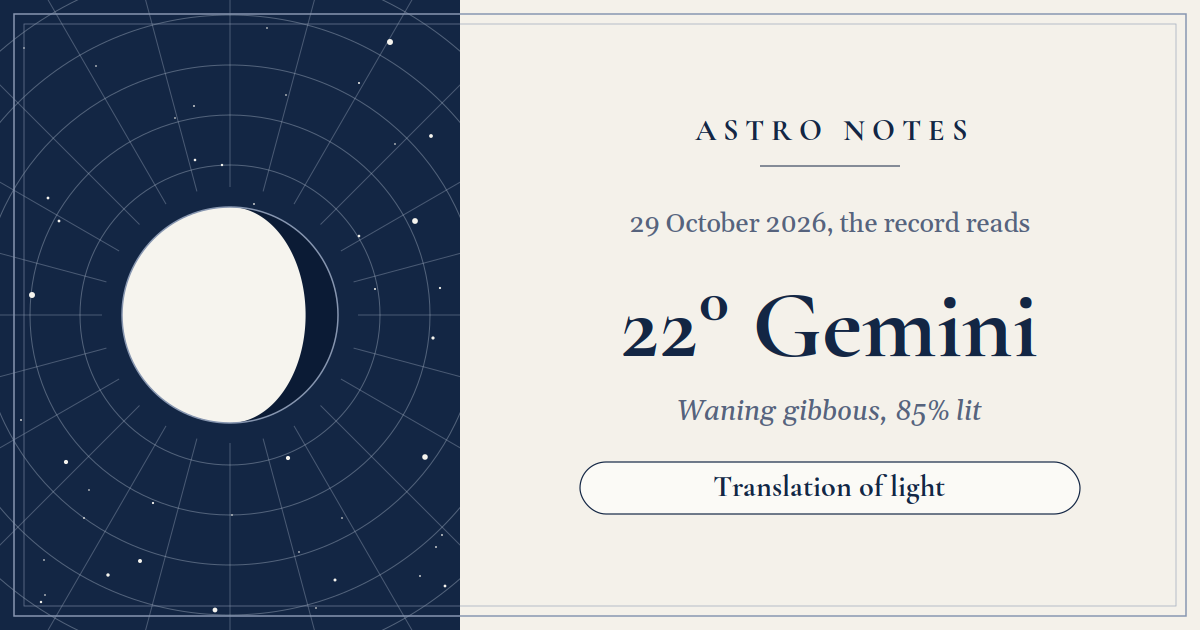
The Moon passes from Jupiter to Venus this evening; the horary writers called it translation of light.
The record for 29 October 2026
22° Gemini
Waning, void from 21:43 UTC.
0h · 6h · 12h · 18h
Sign
Gemini, twenty-two degrees
Phase
Waning gibbous
Condition
Peregrine
The word to know today
Translation of light
A swift planet separates from one body and applies to another, carrying the light of the first to the second. The horary writers read it as a matter brought together by a go-between.
Eighty-five percent of the disc is lit this morning, and the Moon stands at twenty-two degrees of Gemini, waning. Before she leaves the sign she touches two planets in turn: a sextile to Jupiter at 16:18 UTC, then a trine to Venus at 21:43 UTC, the sextile an aspect of sixty degrees and the trine one of a hundred and twenty.
The old name for this pattern is translation of light. When a swift planet separates from one body and applies to another, it was said to carry the light of the first to the second, joining two planets through itself. The horary writers allowed it to bring a matter about even when the two planets made no aspect of their own.
Jupiter and Venus, the two benefics of the old scheme, are closing on a sextile of their own, Venus retrograde in Libra and Jupiter in Leo. Venus, moving backward, comes back toward Jupiter while the Moon runs forward between them, from one to the other in five and a half hours.
The Arabic writers, Abu Ma’shar in ninth century Baghdad among them, set out the many ways one planet could relate to another, and translation belongs to that family of doctrines. It reaches Lilly in 1647 as a way a question could be resolved through a third party.
The trine to Venus is her last aspect in Gemini, and four hours and twenty-two minutes of void follow it. Carrying Jupiter’s light to Venus is the last work she does in the sign.
From the shelf
Abu Ma’shar
Ninth century Baghdad, whose introduction to astrology sets out the configurations between planets, from their connections to the void in course.
Six short letters and one long one, every week
Read the record each morning.
Monday to Saturday, the Moon's sign today and what the old texts made of it. On Sunday, the week ahead for all twelve signs. Free.